
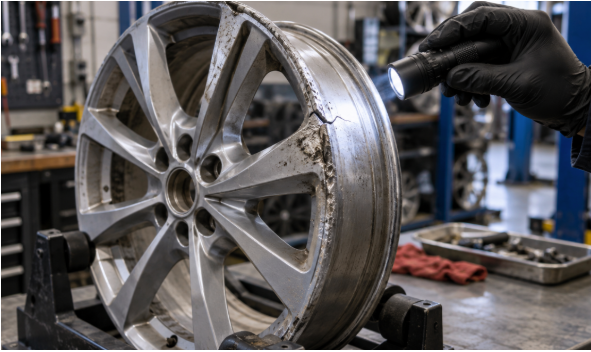
A scraped wheel can look worse than it really is. A small crack, meanwhile, can be more serious than it appears. That makes wheel damage tricky to judge from the driveway.
Wheels support the tires and carry loads during braking, turning, and everyday driving. When damage affects their shape, strength, or ability to hold a tire securely, appearance becomes a secondary concern. Knowing when to replace a wheel starts with separating surface damage from structural problems.
Bent Wheels Need More Than Balancing
Potholes and curb impacts can bend a wheel’s rim flange or distort its barrel. You might notice vibration, repeated pressure loss, or a change in how the vehicle drives.
However, those symptoms can also come from tires, suspension parts, or other problems. Have the wheel inspected and its runout measured to determine whether it rotates within the manufacturer’s limits.
Balancing does not straighten a bent wheel. Replacement is appropriate when deformation makes the wheel unserviceable or the manufacturer prohibits straightening. Do not assume a repair is approved simply because someone offers it.
Cracks Are a Reason to Stop Using the Wheel
A confirmed crack in the wheel’s metal should be treated as structural damage, even if the tire still holds air.
Cracks can occur around the rim, spokes, or mounting area. Some are difficult to see without removing the wheel and tire. A technician can also distinguish a crack in the finish from one extending into the metal.
Replacement is the safe course for a structurally cracked passenger-car wheel. Welding or heating should not be assumed to restore its original strength. Published manufacturer guidance prohibits these repairs on certain aluminum wheels. Wheel inspection and refinishing guidance
Corrosion Depends on Depth and Location
Flaking paint, light surface rust, or white oxidation does not automatically mean a wheel needs replacement. Some surface deterioration may qualify for cleaning and refinishing under the applicable manufacturer’s procedures.
Deep pitting, substantial metal loss, or corrosion around critical mounting areas is different. Damage where the tire seals against the wheel may also cause persistent leaks.
Industry guidance identifies severe corrosion and excessive wear at mounting surfaces as replacement conditions. A fresh coat of paint cannot restore missing metal or correct a weakened attachment area. Wheel safety and service guidance
Know When to Park the Vehicle
If you discover a crack, major deformation, rapid pressure loss, or severe vibration, stop somewhere safe and arrange assistance. Avoid continuing at highway speed to see whether the problem improves.
A suitable spare may provide temporary mobility when installed safely and used within its stated limits. Otherwise, arrange towing.
Never hammer a wheel back into shape or cover suspected cracks with filler. Those steps can hide damage without making the wheel safe.
Have the Tire Checked Too
An impact strong enough to damage a wheel may also injure the tire. Ask for an inspection of the sidewalls, bead area, and internal structure when appropriate.
Tell the technician when the symptoms started and whether you struck a pothole or curb. That history helps guide the inspection. Replacing the wheel alone may leave related damage unresolved.
Choose a Replacement That Fits Correctly
Matching the wheel’s appearance is not enough. The replacement needs suitable dimensions, bolt pattern, offset, center bore, load capacity, and clearance for the vehicle’s brakes.
The mounting hardware must also match, and installation should follow the specified torque procedure.
A damaged wheel does not always mean replacing all four. What matters is using an approved, compatible replacement and confirming that the remaining wheels and tires are serviceable.
This post was written by a professional at Tires2Go Florida. Tires2Go Florida is a trusted automotive service center located in Pinellas Park, Florida, serving drivers across St. Petersburg, Tampa, Clearwater, and Largo. Our certified mechanics handle tire and wheel replacement, brake service, suspension repairs, oil change Pinellas Park FL, wheel alignments, tire balancing, and road force balancing. We also specialize in ADAS calibration, suspension modifications, lift kits, and lowering kits using quality parts and modern diagnostic equipment. From routine maintenance to advanced automotive services, Tires2Go Florida provides dependable solutions and tires for sale for vehicles throughout the Tampa Bay area.
